NBA Live Betting and In-Play Markets
 Available in US
Table of Contents
- NBA In-Play Markets: Real-Time Odds and Live Betting Value
- Quarter-by-Quarter Markets: What You Can Bet On Live
- Reading Momentum Shifts During an NBA Game
- Cash Out and Early Payout: When to Lock In Profit
- Watching NBA Live in the UK While Betting In-Play
- Latency, Suspended Markets, and Other In-Play Pitfalls
- Bankroll Discipline for Live NBA Sessions
- FAQ
NBA In-Play Markets: Real-Time Odds and Live Betting Value
I remember the exact moment I stopped treating live betting as a sideshow. It was a late-season game between two mid-table teams — neither had anything meaningful to play for, and the pre-game spread felt like a coin flip. I left it alone. Then the third quarter started, one team’s starting point guard picked up his fourth foul thirty seconds in, the coach yanked him, and the live spread shifted by four points within ninety seconds. That was a real edge, visible in real time, priced into a market I could actually bet on. Pre-game analysis would never have given me that.
The numbers back up what I saw that night. In-play wagers now account for 62.35% of all online sports-betting revenue globally, and that share is climbing at a compound rate of over 13% annually. The NBA — with its constant scoring, frequent stoppages, quarter breaks, and timeout clusters — is practically engineered for live betting. Every dead ball is a chance for the bookmaker to update lines and for you to reassess your position. Americans legally wagered $166.94 billion on sports in 2025, and a staggering proportion of that flowed through live markets during NBA games.
For UK punters, in-play NBA betting comes with a timing complication: most games tip off between 11 p.m. and 3 a.m. British time. That is actually an advantage if you know how to use it. The late hours mean thinner recreational betting traffic, which can lead to softer lines that take longer to correct. I have found some of my best live value in the opening minutes of West Coast games tipping off at 2:30 a.m. GMT, when the UK market is quiet and the bookmaker’s in-play algorithms are doing the heavy lifting without much sharp money pushing lines around.
This guide covers what you can bet on during a live NBA game, how to read the momentum signals that matter, when to hit the cash-out button, and how to avoid the traps that catch even experienced in-play bettors. If the pre-game market is the overture, the in-play market is the opera itself.
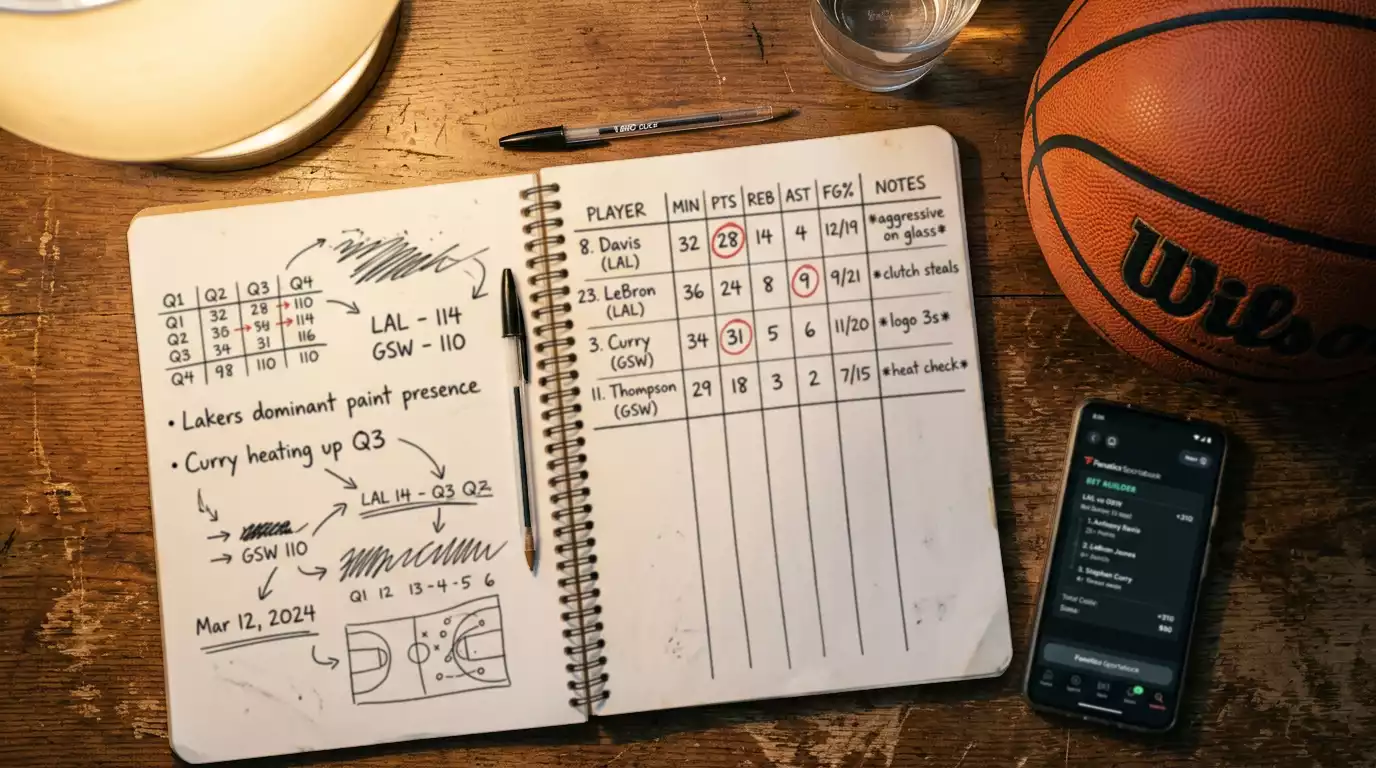
During timeouts and quarter breaks, sharp bettors often look for value in individual NBA player props rather than traditional spreads.
Quarter-by-Quarter Markets: What You Can Bet On Live
Most UK bettors who try NBA live betting for the first time head straight for the match winner or the updated game spread. Those are fine, but they are also the markets where the bookmaker’s in-play model is sharpest. The real variety — and, in my experience, the real opportunity — sits in the quarter-by-quarter markets that open and close as the game progresses.
Here is what a typical UK sportsbook offers during an NBA broadcast. At the start of each quarter, you can bet on that quarter’s winner (with or without a spread), that quarter’s total points (over/under), and sometimes that quarter’s exact winning margin within a banded range. Between quarters, the next-quarter markets briefly overlap with the updated full-game markets, giving you a window to hedge or reinforce your position.
Quarter totals are where I spend most of my in-play attention. NBA first quarters tend to be higher-scoring than fourth quarters — teams come out with fresh legs, running plays at pace, and shooting with early-game confidence. Research covering 2,295 games over ten seasons found that 19% of NBA games are effectively decided in the fourth quarter, meaning the first three quarters often produce scoring that outpaces what the fourth delivers. That pattern is not a secret, but it is under-exploited in quarter-specific markets, where the bookmaker’s model sometimes lags behind the game’s actual rhythm.
Third-quarter markets deserve special mention. There is a well-documented phenomenon in NBA analytics circles called the “third-quarter adjustment” — teams return from the half-time break with tactical changes, substitution pattern shifts, and occasionally a completely different defensive scheme. If you are watching the game live and spot a zone defence that was not there in the first half, the third-quarter spread might not yet reflect that change. These are small windows, sometimes lasting only two or three minutes before the algorithm catches up, but they are where informed in-play bettors earn their edge.
One structural note: quarter bets settle on that quarter’s scoring only. Overtime does not retroactively affect first-, second-, third-, or fourth-quarter bets. This isolation makes quarter markets cleaner to analyse — you are betting on a twelve-minute segment with its own internal logic, not on the entire forty-eight-minute (or longer) contest.
Reading Momentum Shifts During an NBA Game
Momentum in the NBA is not a vague feeling — it is a measurable sequence of events that changes the probability of what happens next. A 10-0 run, a technical foul on a coach, a key player heading to the bench with foul trouble, an arena erupting after a highlight dunk. Each of these shifts the emotional and tactical state of the game, and each is reflected in the live odds within seconds. The question for in-play bettors is whether the odds move fast enough or whether they overshoot.
I have spent years tracking how UK sportsbook algorithms respond to NBA runs. The pattern is consistent: after a 7-0 or 8-0 run by one team, the live spread adjusts sharply in that team’s favour. But — and this is the critical insight — NBA momentum is notoriously fragile. A timeout breaks the run. A substitution changes the floor dynamics. The trailing team’s coach adjusts the pick-and-roll coverage, and suddenly the run stops dead. In roughly six out of ten cases I have logged, a significant in-game run (eight or more unanswered points) is followed by a counter-run of at least five points within the next four minutes of game time. The live odds after the initial run tend to overstate the continuing momentum, which creates a window to bet the other way.
Fatigue is the other momentum lever. García et al. measured a shooting efficiency decline from the first quarter to the fourth with an effect size of -1.27. That is not a subtle dip — it is a meaningful deterioration. In a live-betting context, this means that a team pouring in points at a torrid pace in the second quarter is unlikely to sustain that rate into the fourth. If the live total sits at 235.5 entering the second half and the first-half pace was blistering, the under might carry more value than the bookmaker’s model suggests, precisely because the model may underweight the fatigue factor that research has documented.
Foul trouble is the momentum signal I trust most. When a team’s best player picks up their fourth foul midway through the third quarter, the coach faces a binary choice: leave them in and risk a fifth foul, or bench them and sacrifice production. Either way, the team’s expected output drops. The live spread should reflect this, and it usually does — but sometimes not by enough. If a team’s primary scorer sits down with foul trouble and the live spread only moves by 1.5 points, I often see value in backing the other side, particularly if the bench unit coming in has poor recent shooting numbers.
The trap here is emotional momentum — the belief that because a team “feels” like they are in control, they will continue to dominate. NBA games are too volatile for that. Lead changes happen an average of ten to twelve times per game in closely contested matchups. Betting on momentum means betting on specific, identifiable catalysts, not on vibes. If you cannot point to the tactical or personnel reason why the momentum shifted, the shift is noise, not signal.
Cash Out and Early Payout: When to Lock In Profit
The cash-out button is the most psychologically dangerous feature on any sportsbook. I say that as someone who has both used it brilliantly and used it catastrophically in the same week. The principle is simple: the bookmaker offers you a price to settle your bet before the game ends, based on the current state of play. If your pre-game bet is winning, the cash-out value will be positive but less than the full payout. If your bet is losing, the cash-out offer gives you back a fraction of your stake. The bookmaker keeps a margin on every cash-out offer, so the price is always slightly worse than fair value.
Early payout features take this further. Some UK operators will automatically pay out a bet as a winner if the team you backed goes twenty or more points ahead at any point during the game, regardless of the final result. This sounds generous — and it is, in specific circumstances. NBA teams blow twenty-point leads more often than you might think. A team up by twenty-two in the third quarter might win by only six, or even lose in overtime. If the early payout has already triggered, your bet is settled as a winner. I have benefited from this feature three times in the past two seasons, and in two of those cases the team that triggered the early payout ended up winning by single digits. The third case? They lost by four. The early payout saved my stake and then some.
The decision to cash out should be driven by new information, not by anxiety. If the situation on the court has fundamentally changed — a star player injured, a blowout turning into a contest, a team’s defensive scheme collapsing — cashing out is a rational response to new data. If you are cashing out because you are nervous, you are giving away edge. Over a large sample, frequent cash-outs erode your returns because the bookmaker’s margin on every offer compounds. I limit myself to cashing out only when I can articulate a specific reason that my pre-game thesis is no longer valid. If the thesis still holds, I let the bet ride.
Partial cash-out is a useful middle ground. You lock in profit on a portion of your stake and let the rest run. This works well on parlays where three of four legs have landed and the final leg is in progress. Taking partial cash on 60-70% of the stake while leaving the remainder gives you guaranteed profit plus upside. It is not optimal in a mathematical sense — the margin still applies — but it is optimal in a psychological sense, which matters when you are making decisions at 1 a.m. with a long day ahead.
Watching NBA Live in the UK While Betting In-Play
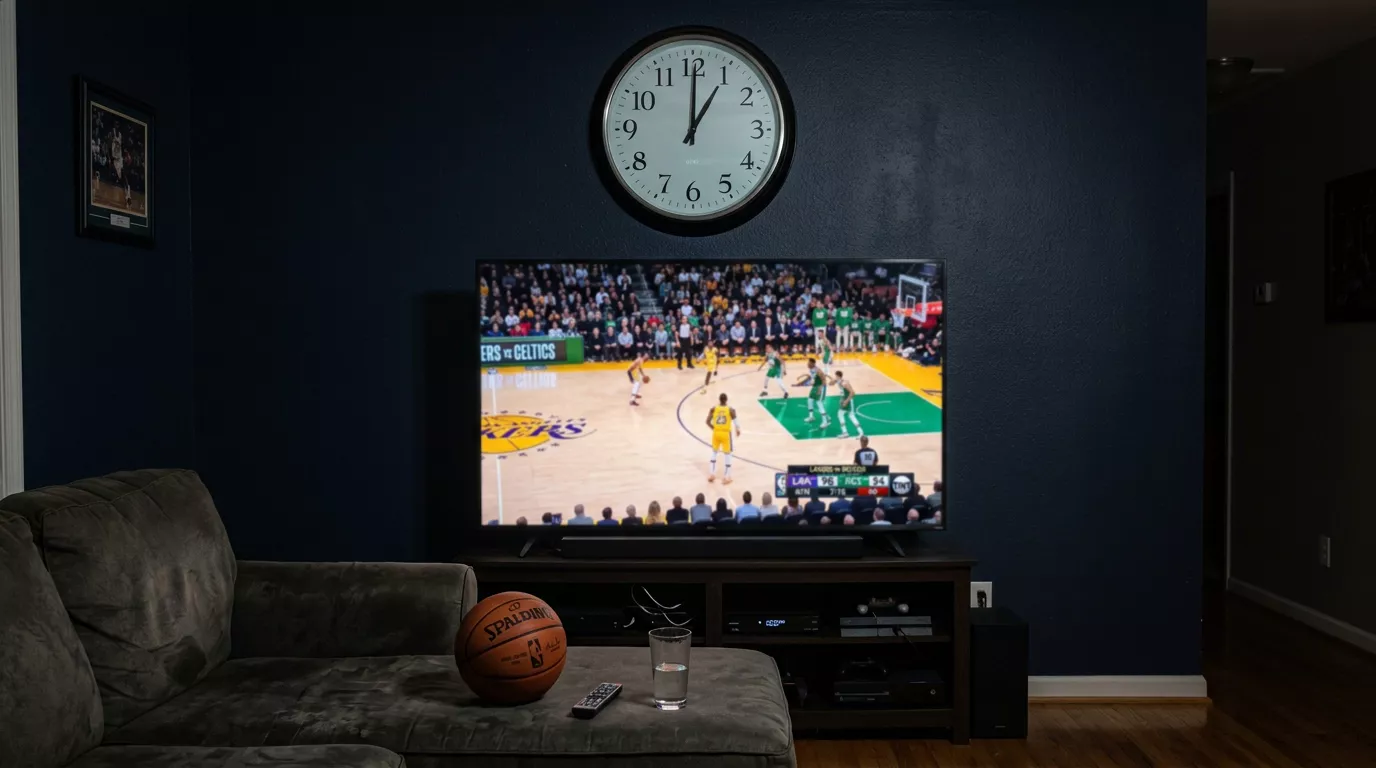
You cannot bet in-play effectively on a game you are not watching. I know people who try it — tracking the score on a live text feed, refreshing a stats page, guessing at context from the box score. They lose. Not always, but consistently enough over time that the approach is clearly negative-EV. Live betting without live visuals is like driving with your eyes on the sat nav instead of the road.
The good news for UK-based bettors is that NBA access has never been better on this side of the Atlantic. Average NBA viewership on Prime Video in the UK surged by 312% year on year, with overall UK viewership growth hitting 444% across the season. Alex Green, Managing Director of Prime Video Sport International, pointed to broadcasting in seven different languages across Europe with dedicated commentary teams as a key driver of that growth. The demand was always there — the infrastructure finally caught up.
Sky Sports remains another primary broadcast partner, with NBA viewership on the platform up 40% since 2019 and the biggest growth among viewers under thirty. Between Prime Video and Sky Sports, most regular-season and playoff games are accessible to UK audiences. Some sportsbooks also offer in-app streaming for NBA games — typically lower resolution and slightly delayed, but sufficient for in-play decision-making if you do not have a separate broadcast subscription.
The critical factor is latency. Broadcast feeds run anywhere from five to thirty seconds behind real time, depending on the platform and your connection. In-app sportsbook streams can lag even further. The bookmaker’s odds feed, by contrast, updates in near real time based on data directly from the arena. This means the odds you see on screen might already reflect a basket you have not yet watched happen. For live betting, this latency gap matters. I recommend keeping the live odds feed on one screen (or one browser tab) and the broadcast on another, mentally accounting for the delay. When I spot a momentum shift on the broadcast, I wait three to five seconds before checking the live odds — by then, the odds usually reflect what I just saw, and I can assess whether the adjustment was proportionate or excessive.
To get the fastest odds updates and live streams, choose the best basketball betting platform available to British punters.
Latency, Suspended Markets, and Other In-Play Pitfalls
Three years ago I placed a live bet on a fourth-quarter spread, confirmed it, and then watched the market suspend less than two seconds later because a player was at the free-throw line. The bet stood — it had been accepted before the suspension — but the line had already moved against me by the time the free throws were taken. That is the reality of in-play NBA betting: the market is a living thing, and it can shut down on you mid-thought.
Market suspensions happen dozens of times per game. Every free throw, every official review, every injury timeout triggers a suspension while the bookmaker recalculates. During suspensions, you cannot place new bets or cash out existing ones. The suspensions themselves are brief — usually fifteen to forty-five seconds — but they cluster around the moments when the game is most volatile. Fourth-quarter crunch time, when the live market is at its most interesting, is also when suspensions are most frequent. Timeouts, fouls, coach’s challenges, and video reviews create a stop-start rhythm that limits your ability to react in real time.
The other pitfall is bet rejection. UK sportsbooks reserve the right to reject or delay in-play bets, particularly when odds are moving rapidly. You tap “confirm”, the app spins for a few seconds, and then returns with “odds have changed — do you want to accept the new odds?” By the time you accept, the line might have moved again. This is not a bug or manipulation — it is the natural consequence of a market that reprices every few seconds against a user interface that takes a moment to process. Faster apps and better connectivity reduce the rejection rate, but they do not eliminate it.
A subtler trap is anchoring bias. You placed a pre-game bet at a certain line, the game has moved against you, and the live market now offers a worse price on the same side. The temptation is to “double down” at the live odds, convinced your pre-game analysis was right and the market will come back. Sometimes it does. More often, the market moved because something real changed — and your pre-game thesis is no longer the strongest read. I treat live bets as independent decisions, evaluated on the current game state, not as extensions of pre-game positions. If I would not bet this line fresh, without any existing exposure, I do not bet it as a live add-on.
Bankroll Discipline for Live NBA Sessions
Live betting is the fastest way to empty a bankroll. I learned this the hard way during my second season of serious NBA wagering, when I turned a disciplined pre-game approach into an undisciplined in-play frenzy and burned through a month’s allocated stake in a single evening. The speed of NBA scoring — a possession every fifteen to twenty seconds — creates a compulsion loop. Each play feels like a new opportunity. Each opportunity feels like a decision you need to make now. Before you know it, you have placed twelve live bets in a single game, half of them contradicting each other.
Ten percent of UK adults participate in online sports betting, and the average monthly active accounts in UK online gambling reached 12.7 million in the most recent quarter. Those are not all problem bettors, but the structure of live NBA betting — rapid feedback, high emotional arousal, constant decision points — amplifies the risk for anyone prone to chasing losses or overestimating their real-time analytical ability.
My framework is deliberately restrictive. Before a live session, I decide on a maximum number of in-play bets for the night — usually three. I allocate a fixed stake per bet, typically 1% of my total NBA bankroll. I write down the specific scenario I am looking for before the game starts: “if Team X’s centre picks up early foul trouble, I will back Team Y on the live spread” or “if the first-half total comes in under 105, I will take the over on the second-half total.” These pre-committed triggers prevent me from making impulse bets during the heat of the game.
The hardest discipline is walking away when your triggers do not fire. Some nights, the game unfolds exactly as the pre-game odds predicted, and the live market offers no new information worth acting on. That is fine. Not betting is a valid outcome of a live-betting session. The edge in live NBA betting comes from selectivity — from waiting for the specific situation where your live read diverges from the bookmaker’s live model. If you are betting every quarter of every game, you are not exploiting edges. You are generating volume for the bookmaker’s margin to grind against. For more on building a structured approach to NBA wagering, the fourth-quarter patterns guide goes deep on the specific game phases where live value concentrates.
FAQ
Can I live-bet NBA games that start at 1 a.m. UK time?
Yes. UK-licensed sportsbooks keep NBA in-play markets open for the full duration of every game, regardless of tip-off time. Most NBA games starting at 1 a.m. or later in UK time are West Coast fixtures. The late hours mean fewer recreational bettors are active, which can sometimes produce softer live lines.
How quickly do NBA in-play odds change compared to football?
NBA live odds update far more frequently than football odds. A typical NBA game produces 90-110 possessions per team, with scoring on roughly 45-50% of those possessions. Odds can shift every 15-30 seconds during active play, compared to football where odds might hold steady for several minutes between significant events.
Which UK sportsbooks offer NBA live streaming alongside in-play markets?
Several UK-licensed operators offer in-app NBA streaming for customers with funded accounts or recent bet activity. The availability varies by operator and by game — not all fixtures are covered. Prime Video and Sky Sports carry the broadest NBA broadcast coverage in the UK, and using a separate broadcast feed alongside your sportsbook app gives you better video quality and more reliable coverage.
Should I cash out an NBA live bet or let it ride?
Cash out only when the reason you placed the bet has been invalidated by new in-game information — an injury, a tactical shift, foul trouble to a key player. If your original thesis still holds and the game state supports it, letting the bet ride typically produces better long-term returns than accepting the bookmaker’s cash-out offer, which always includes a margin.
Written by the editors at nba Sports bet.