NBA Bet Types and Basketball Markets Explained
 Available in US
Table of Contents
- Basketball Bets Explained: Key Rule Differences for UK Punters
- Point Spread (Handicap) Betting: The NBA Standard
- Moneyline Betting: Picking the Winner Outright
- Over/Under Totals: Betting on Combined Points
- Parlays and Accumulators: Combining NBA Bets
- Teasers, If-Bets, and Round Robins
- How Overtime Affects Each Bet Type
- Which Bet Type Suits Your Style
- FAQ
Basketball Bets Explained: Key Rule Differences for UK Punters
I placed my first NBA bet the same week I placed my hundredth Premier League bet, and within twenty minutes I knew the two sports had almost nothing in common from a wagering perspective. A football match might produce two or three goals across ninety minutes. An NBA game regularly tops 220 combined points in forty-eight minutes of clock time. That difference in scoring volume changes everything — the types of bets available, how odds move, how quickly your position can swing from profitable to dead.
Basketball now accounts for 15-18% of global sports-betting activity, and the NBA alone drives roughly 60% of all basketball wagers worldwide. The global basketball betting market sits between $8.7 billion and $10 billion, heading toward $17-18 billion by the early 2030s. Those are not niche numbers. For UK punters raised on football accumulators and horse racing each-way bets, the NBA represents a fundamentally different animal — one that rewards a different skill set and demands a different vocabulary.
The high-scoring nature of basketball means spreads matter more than outright winners. Totals markets are deeper and more granular. Parlays behave differently because individual legs correlate in ways football bets rarely do. And the sheer pace of the game — possessions lasting under twenty-four seconds, lead changes happening every few minutes — makes live betting not just viable but dominant. In-play wagers now generate 62.35% of online sports-betting revenue globally, and NBA games are among the most heavily traded in-play events on any sportsbook.
This guide breaks down every NBA bet type you will encounter at a UK-licensed bookmaker, from the bread-and-butter point spread to the more exotic teasers and round robins. If you have spent years betting on football and want to understand why NBA markets work on entirely different logic, this is where that education starts. For a deeper look at each individual bet type, I have written dedicated guides on point spreads, totals, and moneylines that go further than the overviews here.
Point Spread (Handicap) Betting: The NBA Standard
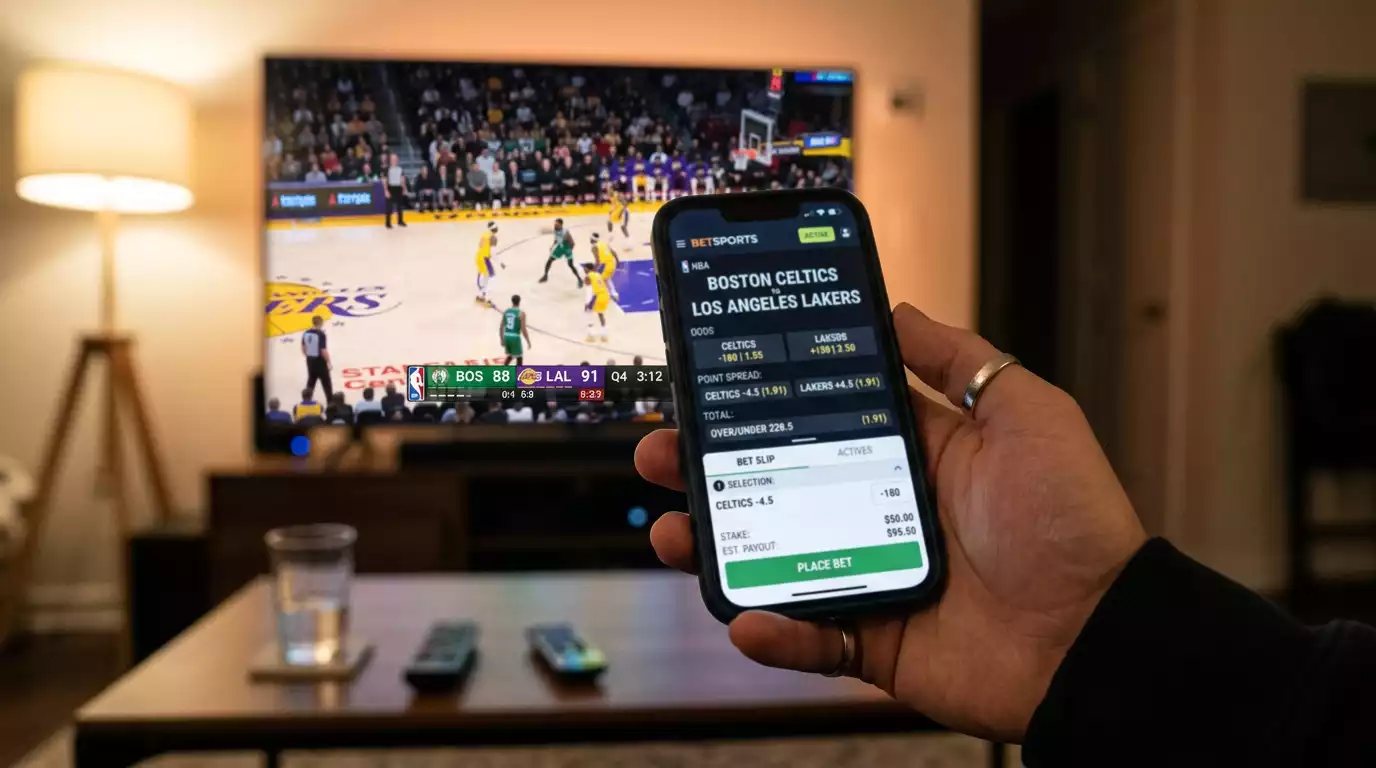
The first time a UK bettor opens an NBA market, the spread is usually what stares back. In football, you might see Asian handicap lines on occasion. In basketball, the point spread is the default — the market around which everything else orbits. Bookmakers set a margin that the favoured team must win by for a spread bet to land, and the underdog receives that same margin as a cushion.
Say the spread reads Team A -6.5 at 1.91 and Team B +6.5 at 1.91. If you back Team A, they need to win by seven points or more. Back Team B, and they can lose by up to six points and your bet still pays. The half-point eliminates draws on the spread — a deliberate design choice that keeps settlement clean. In football handicap betting, you often see whole-number lines with void or half-win scenarios. NBA spreads almost always use half-points, which simplifies the maths considerably.
Why does the spread dominate? Because NBA games between mismatched teams can finish with fifteen- or twenty-point margins, making a straight winner bet on the favourite almost pointless at short odds. The spread levels the field. Both sides of the line are typically priced near 1.91 in decimal odds, giving the bookmaker a slim margin and the bettor a close-to-even proposition. Research from Wang et al., analysing 2,295 NBA games across ten seasons, found that 19% of games are effectively decided in the fourth quarter — meaning the spread outcome often hangs on those final twelve minutes regardless of how dominant one team looked earlier.
For a full walkthrough of spread mechanics, line movement triggers, and how to read key numbers in NBA spreads, I have a dedicated piece on point spread betting that goes into far more depth than this overview allows.
Moneyline Betting: Picking the Winner Outright
There is a beautiful simplicity to the moneyline — pick which team wins, full stop. No margins, no spreads, no mental arithmetic about whether a six-point lead with two minutes left covers your number. The catch, of course, is the price. When a top-seed hosts a bottom-feeder, the moneyline favourite might sit at 1.10 or lower in decimal odds. You are risking a lot to win very little.
I tend to use moneyline bets in two specific situations. First, when I have a strong opinion that a short underdog will win outright — say, a rested road team priced at 2.40 against a squad on the second night of a back-to-back. The moneyline lets me express that view without needing the underdog to cover a spread I do not care about. Second, when building accumulators. Moneyline legs in a parlay are cleaner than spread legs because you only need to be right about the winner, not the margin. The trade-off is that moneyline favourites shorten your accumulator odds substantially.
One crucial difference from football: NBA games cannot end in a draw. Overtime periods continue until a winner emerges, so the moneyline is always a two-way market. There is no draw option to complicate your thinking or your returns. For a thorough breakdown of when moneyline bets offer genuine value versus when they are a trap, see the full moneyline guide.
Over/Under Totals: Betting on Combined Points
Totals betting asks a different question entirely: forget who wins — how many points will both teams score combined? The bookmaker sets a line, say 224.5, and you bet over or under. I find totals especially useful on nights when I cannot separate two evenly matched teams but have a strong read on the pace of the game.
NBA totals are shaped by factors that barely register in football: offensive and defensive pace ratings, three-point shooting volume, free-throw rates, and fatigue. García et al. documented a shooting efficiency decline from the first quarter to the fourth with an effect size of -1.27, meaning late-game scoring often dips below what early-quarter pace would suggest. That kind of data can tilt a totals bet. A game trending over 230 combined through three quarters might slow dramatically in the fourth as tired legs produce missed shots and longer possessions.
UK sportsbooks also offer team totals — over/under on a single team’s score — and half or quarter totals, which break the game into smaller windows. For a complete guide to totals markets, including how to assess pace matchups and when under bets carry the edge, the dedicated over/under guide covers it all.
Parlays and Accumulators: Combining NBA Bets
Every UK bettor knows what an accumulator is — you have been building them on Saturday afternoon football fixtures since you opened your first account. NBA parlays work on the same principle: combine multiple selections into one bet, multiply the odds, and accept that one wrong leg kills the whole slip. The mechanics are identical. The dynamics are not.
NBA scheduling is what makes basketball parlays different from football accumulators. On a heavy night, twelve or thirteen games tip off within a few hours of each other. That creates a temptation to load up a ten-leg acca across the full slate. I have done it. It never ends well. The problem is correlation. If you back three West Coast home favourites on a Tuesday night, those bets are not truly independent — they share contextual factors like scheduling patterns, referee assignments, and even arena atmospheres on particular calendar stretches. Bookmakers price these legs as independent events, but they are not, and the error works against you more often than it works for you.
My rule of thumb, refined over eight years of working with these markets, is to keep NBA parlays between two and four legs. A two-leg parlay on a spread and a total from the same game is a same game parlay (or bet builder, in UK terminology). A three-leg parlay across three separate games gives you a meaningful odds boost without the catastrophic hit rate of a six-fold or higher. The maths is unforgiving: a four-leg parlay at 1.91 per leg returns roughly 13.31 for a 1.00 stake, but the implied probability of all four landing is only about 7.5%. That looks exciting on a betting slip. It looks less exciting after your thirtieth failed attempt.
Acca insurance and parlay boost promotions are common at UK sportsbooks, and they can soften the blow of a single losing leg. But treat these as damage limitation, not as strategy. If your accumulator only pays because the bookmaker refunded your stake after a near-miss, the underlying selections were not strong enough to begin with.
One structural difference worth noting: in football, you might build weekend accumulators across leagues — a Premier League pick, a Bundesliga pick, a Serie A pick. NBA accumulators tend to cluster around a single night’s slate because all games happen within the same league framework. That makes the research process more concentrated. You are studying one set of injury reports, one set of scheduling quirks, one referee pool. Whether that concentration is an advantage or a disadvantage depends on how thorough your pre-game process is.
Teasers, If-Bets, and Round Robins
Walk into any American sportsbook conversation and you will hear the word “teaser” within five minutes. In the UK, these bet types are less common on sportsbook menus, but they do exist — and understanding them gives you an edge in recognising when a bookmaker is offering you a worse deal dressed up as a special feature.
A teaser lets you adjust the point spread or total in your favour across two or more selections, but at reduced odds. For example, a standard two-team NBA teaser might give you four extra points on each spread. If the original lines were Team A -7.5 and Team B -5.5, a four-point teaser turns them into Team A -3.5 and Team B -1.5. You now need smaller margins, but the payout is much lower — often around 1.83 or less for a two-teamer. The question is whether those four points cross enough key numbers to justify the reduced return. In NBA betting, key numbers are less defined than in American football, where margins of 3 and 7 dominate. Basketball margins are more evenly distributed, which means teasers offer less structural value in the NBA than they do in the NFL.
If-bets are conditional parlays: if the first leg wins, the stake rolls to the second leg. If the first leg loses, the second bet is never placed. This gives you more control over how much you risk on a multi-game night but adds complexity to bankroll tracking. Most UK sportsbooks do not label these as “if-bets” explicitly, though you can replicate the structure manually by waiting for one result before placing the next wager.
Round robins break a group of selections into every possible parlay combination. Pick four games, and a round robin generates all possible two-team parlays, three-team parlays, and the four-team parlay. You bet on every combination. This spreads your risk — one losing leg does not wipe out every parlay — but it also multiplies your total stake dramatically. A four-pick round robin of all combinations means eleven separate bets. At five pounds each, that is fifty-five pounds in total outlay. Beginners often underestimate this.
My honest assessment: teasers, if-bets, and round robins are tools for experienced bettors who understand implied probability and can calculate whether the adjusted odds still carry positive expected value. If you are still learning the difference between a spread and a moneyline, leave these for later. They will still be there when you are ready.
How Overtime Affects Each Bet Type
A colleague once lost a spread bet by half a point because a game went to double overtime and the favourite — who had been coasting — poured it on in the extra periods. He had not checked whether his spread bet included overtime scoring. It did. That lesson cost him forty pounds and a lot of pride.
The default rule at most UK sportsbooks is that moneyline bets and point spread bets include overtime. If a game goes to OT and the favourite wins by twelve after trailing at the end of regulation, that twelve-point margin counts for spread settlement. For totals, overtime points are also included in the standard game total market. This is where bettors get caught — a game heading under 218.5 with two minutes left in regulation suddenly explodes for thirty combined overtime points and sails over.
The exceptions matter. First-half and second-half bets settle on their respective halves only. The second half includes the fourth quarter but not overtime. Quarter-specific bets — first quarter over/under, third quarter spread — settle on that quarter’s scoring alone. Player prop bets generally include overtime stats, which is why a player you expected to score 22 points might hit 30 after two extra periods, blowing past a prop line that looked safe.
Some UK bookmakers offer “regulation time only” markets on totals and spreads, explicitly excluding overtime. These sit alongside the standard markets but carry different odds. If you have a strong view that a game could go to overtime — tight late-season matchups between playoff contenders, for instance — the regulation-only markets let you isolate your bet from the chaos of extra periods. Always check the market rules before confirming your slip. The fine print is not there for decoration.
Double and triple overtime games are rare — roughly 6% of NBA games go to at least one overtime — but they are enormously disruptive to betting outcomes. Total points can spike by twenty or thirty, spreads can flip entirely, and player stat lines inflate beyond any pre-game projection. The low frequency makes these events feel like freak occurrences, but across a full 82-game season with up to fifteen games on a single night, overtime happens more often than you might expect in aggregate. Building awareness of which bets include OT and which do not is a basic hygiene step that every NBA bettor should complete before placing a single pound on the line.
Which Bet Type Suits Your Style
After eight years analysing NBA wagering markets, I have watched enough bettors cycle through every bet type before settling on what actually works for them. The pattern is remarkably consistent: newcomers start with moneylines because they are simple, graduate to spreads because the odds are better, dabble in parlays because the payouts are exciting, and eventually find a lane that matches their temperament and research habits.
If you are methodical and enjoy digging into matchup data, spreads reward that work. The spread market is where sharp money concentrates because the lines are tight and even small informational edges translate into long-term profit. If you are more instinctive and prefer to back teams you believe in, moneyline underdogs offer the clearest path to value without requiring deep statistical analysis. If you enjoy the spectacle of a full night of basketball and want every game to matter, a small parlay across two or three carefully chosen legs keeps the engagement high without the recklessness of a ten-fold acca.
Totals suit bettors who think in systems rather than sides. You do not need to know who will win — you need to know how the game will be played. Pace, defensive intensity, fatigue, altitude (Denver’s home-court advantage includes thin air that can affect shooting and conditioning) — these are totals factors. Adults aged 18-34 make up 41% of the NBA’s audience, and the 25-44 demographic drives 65% of legal sports bets. That skews younger than the typical horse racing or football betting population, and younger bettors tend to gravitate toward player props and same game parlays rather than traditional spreads. There is nothing wrong with that, but props carry higher margins and integrity risks that I cover in the player props guide.
Adam Silver has spoken publicly about the need for more regulation around sports betting, particularly at the federal level. His concern is not that people bet — it is that the betting infrastructure has expanded faster than the oversight mechanisms. That applies to bet types as well. The proliferation of exotic markets means the average UK bettor now faces twenty or thirty different ways to wager on a single NBA game. Not all of those markets are priced efficiently. Not all of them deserve your money. Pick the bet types that align with your research process, learn them deeply, and resist the urge to chase variety for its own sake.
FAQ
What does +4.5 / -4.5 mean in NBA point-spread betting?
The minus figure (-4.5) indicates the favourite must win by five or more points for a spread bet on them to pay out. The plus figure (+4.5) means the underdog can lose by up to four points and your bet still wins. The half-point eliminates any possibility of a push (tied result on the spread), so every spread bet settles as a clear win or loss.
Do NBA parlays include overtime results?
At most UK-licensed sportsbooks, standard moneyline and spread legs in a parlay settle on the final result including all overtime periods. Totals legs also include overtime scoring unless the market is specifically labelled ‘regulation time only’. Always check the settlement rules for each leg before confirming a parlay slip.
Are teasers available for NBA games at UK sportsbooks?
Some UK sportsbooks offer teaser bets on NBA games, typically allowing you to adjust the spread by four to six points across two or more selections at reduced odds. Availability varies by operator, and teasers are far less common in the UK market than in American sportsbooks. Check whether your bookmaker lists them under an ‘alternative lines’ or ‘specials’ tab.
How is NBA handicap betting different from football handicap betting?
The core principle is the same — one side receives a virtual advantage or disadvantage. The key differences are scale and frequency. NBA handicaps typically range from 1.5 to 15 or more points, reflecting the higher-scoring nature of basketball. Football handicaps rarely exceed three goals. NBA spreads also use half-points almost exclusively, whereas football offers whole-number Asian handicaps with split-stake mechanics. Finally, NBA spread bets include overtime by default, while football handicap bets settle on 90-minute results unless stated otherwise.
Created by the ”nba Sports bet” editorial team.